
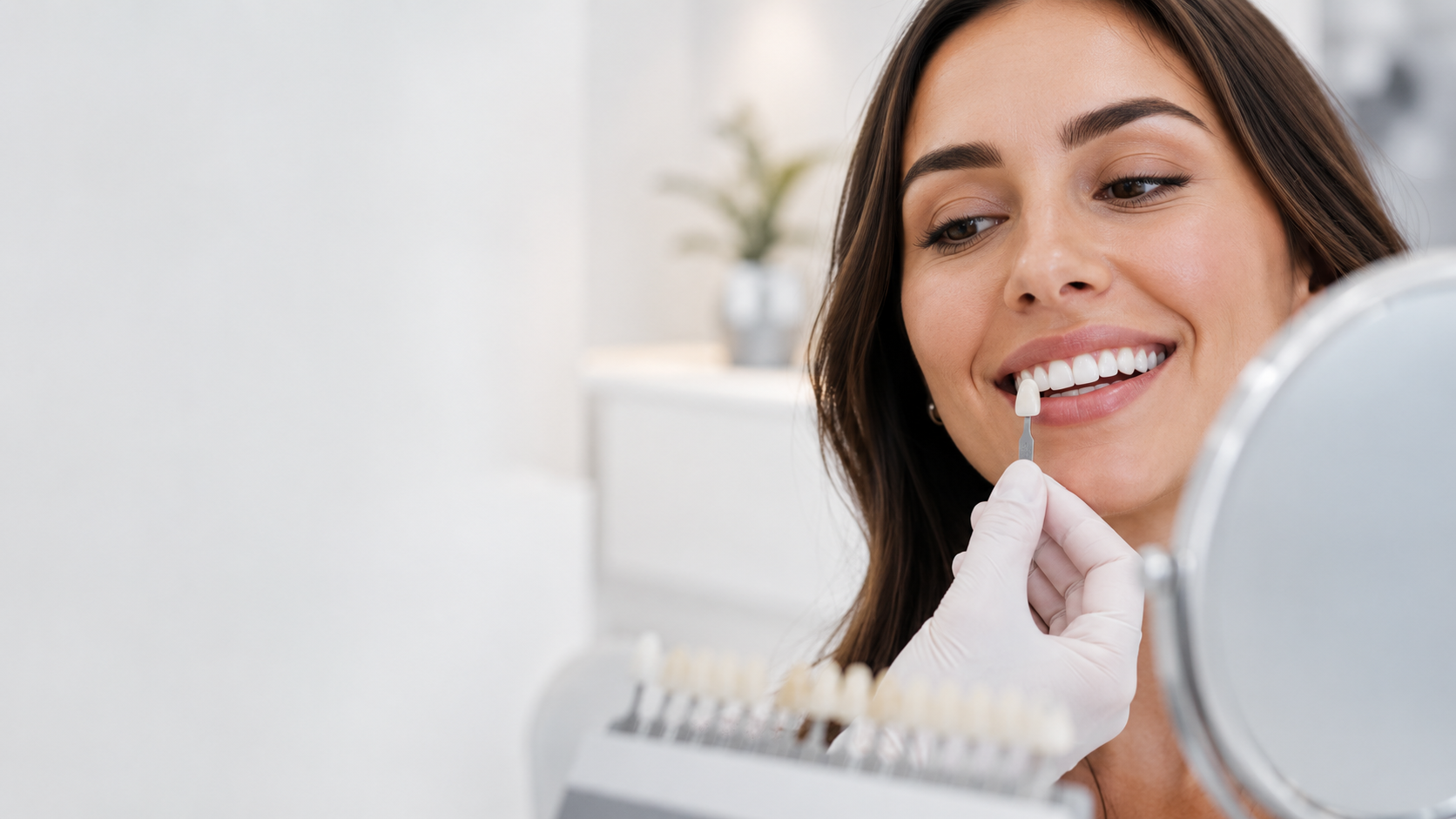
As a dentist practising in Glasgow for over a decade, I have seen porcelain veneers transform not just smiles but lives. Patients come to me with stained teeth, chips, gaps, or teeth that are simply too small or worn down. They want a solution that looks natural, lasts, and feels like their own teeth.
But many people misunderstand what veneers are. They worry about pain, cost, or the possibility that their teeth will be damaged beyond repair. Let me walk you through the facts, the science, and the process from a dentist’s perspective.
What Are Porcelain Veneers?
A porcelain veneer is a thin ceramic shell bonded to the front of a tooth. You will also hear the terms laminate veneers or ceramic veneers. They are designed to mimic the light reflecting properties of natural tooth enamel, giving a result that is both durable and indistinguishable from your own teeth.
Unlike a crown, a veneer only covers the front and biting edge. That means less of your natural tooth structure needs to be removed. For many patients, this conservative approach is one of the main reasons they choose veneer treatment over a crown.
Veneers are made in a dental laboratory using high strength ceramics such as lithium disilicate. The laboratory technicians work from precise impressions or digital scans of your teeth. Because they are fabricated individually, each veneer is matched to the colour, shape, and contour of your adjacent teeth.
Why Choose Porcelain Over Other Materials?
You may have heard of composite veneers. Composite is a tooth coloured filling material that a dentist applies directly to your tooth and shapes in place. The advantage is speed and lower cost. But composite veneers stain more easily, chip more readily, and do not last as long.
Porcelain veneers are fabricated in a dental laboratory from a precise impression of your teeth. They are fired at high temperatures, making them incredibly strong and stain resistant. Coffee, tea, and red wine are less likely to cause discolouration compared to composite or even natural enamel. With proper care, porcelain veneers can last 10 to 15 years or longer.
Who Is a Good Candidate for Porcelain Veneers?
This is the most important question. Excellent hygiene and maintenance of gum health is essential, as well as a low/zero decay rate. If gum shrinkage is an issue, proceed with caution, as any cosmetic restoration will lose its aesthetic appeal if the porcelain margin becomes visible over time. Ideally it is tucked just under the gum margin. Veneers are not for everyone. And a responsible dentist will tell you if you are not a good candidate. Here are the conditions that veneers can address effectively:
- Discoloured teeth that do not respond to whitening
- Chipped or worn teeth
- Gaps between teeth (diastema)
- Teeth that are slightly misaligned or uneven in size
- Teeth with old, failing composite fillings on the front surfaces
Veneers are not the first choice when you have significant tooth decay, active gum disease, or severe malocclusion (bite problems). Those issues need to be treated first. Veneers placed on unhealthy teeth will fail quickly. I always complete a full examination and take diagnostic records before recommending veneers.
The Porcelain Veneers Treatment Process Step by Step
Many patients ask me how many appointments are needed. The answer is typically three. But every case is individual. Here is what you can expect.
Step 1: Consultation and Smile Design
This is the most important appointment. We do not just look at your teeth. We listen to what you want. I take photographs, digital scans, and sometimes a set of impressions. I examine your bite, gum health, and tooth alignment.
Then I use digital smile design software to show you what your new smile could look like. You see the proposed shape, length, and shade before any treatment begins. This removes guesswork and anxiety. You are part of the design process.
I also explain what can and cannot be achieved. Veneers are not a solution for major bite problems or severe misalignment. Those cases may need orthodontics first. Transparency at this stage prevents disappointment later.
Step 2: Tooth Preparation
On the second visit, we prepared the teeth. This is where many patients feel nervous. Let me put your mind at ease. The amount of enamel removed is minimal: generally half a millimetre or less. Most outer surfaces can be left untouched nowadays in cosmetic cases since many patients want to show their teeth just a fraction more and this advances the outer surfaces under the lip just a little. O.5mm is roughly the thickness of a fingernail.
I use a local anaesthetic to keep you comfortable although will happily avoid it if patients prefer a needle free technique. If required, I shape the front surface of each tooth to create space for the veneer. Usually 0.5-1mm reduction of the biting edge is required. After preparation, I take a final impression or digital scan. This goes to the dental laboratory.
While your permanent veneers are being made, I fit temporary veneers. These protect your prepared teeth and let you preview the look and feel of your new smile. You can eat, speak, and smile normally during the waiting period.
Step 3: Bonding the Veneers
Two to three weeks later, your porcelain veneers return from the lab. I remove the temporaries and clean your teeth thoroughly. Then I try each veneer in place to check fit, colour, and contact with neighbouring teeth.
Only when everything is perfect do I start bonding. I etch the tooth surface with a mild acid to create micro pores. Then I apply a bonding agent and a special resin cement. The veneer is placed and cured with a high intensity light. The bond is incredibly strong, often stronger than the tooth itself.
I check your bite and make any minor adjustments. Finally, I polish the edges so they feel smooth against your tongue and lips. The result is instant.
Step 4: Follow Up
I schedule a follow up appointment two weeks later to check your gums, bite, and overall satisfaction. Most patients adjust to the feel of veneers within a few days. Your gums may feel slightly tender initially but settle quickly.
What About the Recovery and Aftercare?
There is no real recovery period. You can eat and drink normally after the anaesthetic wears off. The temporary veneers are weaker than permanent ones, so I advise avoiding very hard or sticky foods during the wait period.
After placement, treat your veneers like natural teeth.
- Brush twice daily with a non abrasive toothpaste
- Floss once daily, or clean in between your teeth with ‘tepe’ brushes daily, paying attention to the gum line around each veneer
- See your dentist for regular checkups and hygienist every 3-6 months to manage gum health.
Porcelain veneers do not decay, but the tooth underneath can still develop cavities if you neglect oral hygiene. The gum margin around the veneer also needs to stay healthy. Avoid using your teeth as tools. Do not bite fingernails, open packages, or chew ice. If you grind your teeth at night, a custom night guard will protect both your veneers and natural teeth.
Tooth sensitivity after veneers is uncommon but can occur for a few days after preparation. It usually resolves quickly.
What Are the Risks and Alternatives?
I believe in honest communication. Veneer preparation is irreversible because enamel is removed. That means you will always need some form of restoration on those teeth. Veneers can chip or fracture if subjected to excessive force, such as biting hard objects or grinding without a guard. They may need replacement after a decade or more. There is a small risk that the colour of your natural teeth may change over time, creating a mismatch if you only veneer a few teeth.
Alternatives include:
- Composite bonding – less invasive and less expensive, but less durable and more prone to staining
- Invisalign – for significant misalignment, often a better first step
- Dental implants – for missing teeth, for both functional and cosmetic improvement
Sometimes I combine treatments. For example, Invisalign to straighten teeth followed by veneers to perfect shape and colour. Your goal should be a result that looks natural, functions well, and lasts. That requires careful planning and skilled execution.
How Long Do Veneers Last?
Veneer longevity depends on several factors: the quality of the original bonding, your oral hygiene, and how you use your teeth. With proper care, porcelain veneers can last 10 to 15 years or longer.
They are stain resistant, so coffee, tea, and red wine are less likely to cause discolouration compared to natural enamel. However, the underlying tooth can still decay if hygiene is poor.
Veneer maintenance is straightforward. Brush twice a day with a non abrasive toothpaste. Floss daily, paying attention to the gum line around each veneer. See your dentist for regular checkups.
If you grind your teeth at night, a custom night guard will protect both your veneers and natural teeth. Over time, the gum margin may recede slightly, and the edge of the veneer may become visible. That is normal. At that point, you may consider veneer replacement.
How Much Do Porcelain Veneers Cost in Glasgow?
Pricing varies based on the number of veneers, the material used, the complexity of your case, and the expertise of the dentist. At our practice, we provide a detailed treatment plan with a transparent quote after your consultation. We also discuss payment options. It is not the cheapest option for smile makeovers, but for many patients the durability and natural appearance justify the investment. Depending on the materials used and number of veneers placed during each visit we price porcelain veneers between £450-550 each.
What to Do Next
If you are considering porcelain veneers in Glasgow, start with a consultation. Do not rely on online photos or social media filters. Come and see me at Crystal Dental Care. I will examine your teeth, discuss your goals honestly, and show you a digital preview of your new smile.
The process is straightforward. The results can be life changing. But only when you work with a dentist who understands the craft.
I reserve time in my week for new patient consultations which are free of charge for 1st time appointees. You can book online or call the practice directly. I look forward to meeting you and helping you achieve the smile you deserve.