
You have seen the adverts. The Instagram stories. The celebrities are wearing clear plastic trays.
Invisalign has become the most talked about orthodontic treatment in the UK. But for every person who has tried it, there are many more who still wonder: what actually is this system, and does it really work?
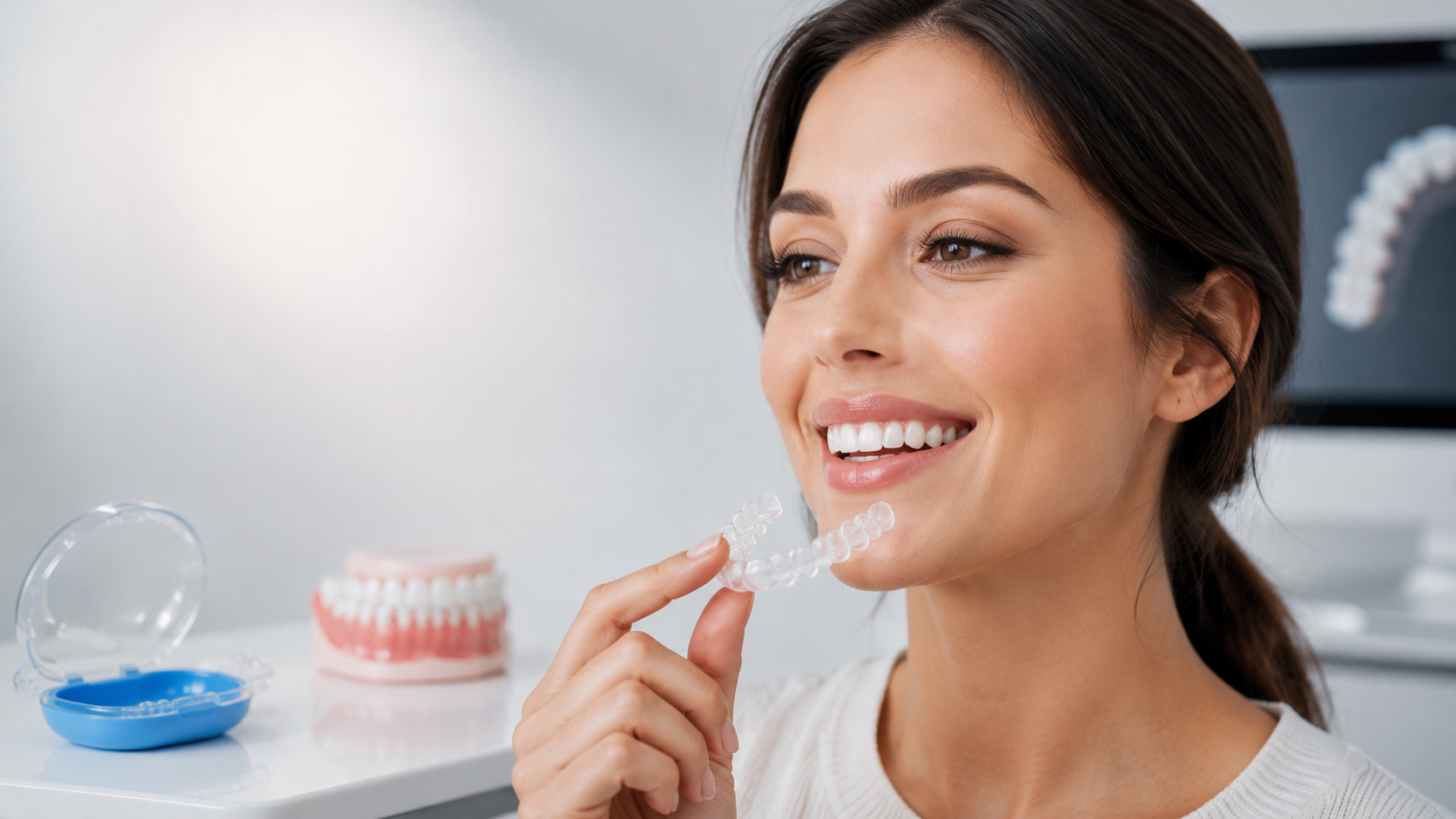
Invisalign is a modern alternative to fixed metal braces. It uses a series of custom made transparent aligners to straighten teeth gradually.
It appeals to adults and teenagers who want to improve their smile without the look and feel of traditional brackets and wires.
At Crystal Dental Care in Glasgow, we have used Invisalign to treat hundreds of patients. From mild crowding to complex bite corrections. This guide walks you through everything you need to know.
What Is Invisalign?
Invisalign is a brand of clear aligner orthodontic treatment developed by Align Technology. It consists of a set of custom made transparent trays that fit snugly over your teeth.
Each tray is worn for one to two weeks before moving to the next in the series. Over time, the teeth shift into their corrected position. This is a form of controlled tooth movement. It relies on a carefully designed sequence of aligner trays.
What sets Invisalign apart from generic clear aligners is the system behind it.
The aligners are made from a patented material called SmartTrack material. This thermoplastic has specific elastic properties. It delivers a consistent, gentle orthodontic force throughout the wear period.
Combined with the ClinCheck treatment plan, a software used by your dentist to plan every millimetre of movement, Invisalign offers a level of predictability that many DIY aligner companies cannot match.
The digital treatment planning includes a 3D treatment simulation and a digital smile preview. You see your final result before you start.
The key difference from traditional braces is the lack of fixed brackets and archwires. Invisalign aligners are removable. You take them out to eat, drink, brush, and floss. This makes oral hygiene much simpler and eliminates dietary restrictions.
However, the removable nature places responsibility on you. Treatment success depends on wearing the removable aligners 20 to 22 hours per day, every day.
How Does Invisalign Straighten Teeth?
Tooth movement is a biological process. When pressure is applied to a tooth, the bone around it remodels. On the side where the tooth moves, bone fills in. On the opposite side, bone is resorbed. This is called bone remodelling.
Invisalign applies this pressure through a series of aligners. Each aligner is slightly different from the last, typically moving teeth by about 0.25 to 0.33 millimetres per stage. The aligner grips certain teeth using small composite attachments bonded to the enamel. These attachments act as handles, allowing the aligner to exert torque, rotation, and vertical movement.
The treatment planning technology is where Invisalign excels. Your dentist takes a digital scan of your teeth using an intraoral scanner. This scan is uploaded into the ClinCheck software, which simulates the entire movement sequence. Every stage is mapped out, including the positions of attachments and any need for interproximal reduction (IPR). You can see the predicted final result before treatment begins.
Aligners are changed every one to two weeks depending on your protocol. The schedule is designed to keep force levels within a safe, effective range. Changing too soon may cause root resorption or loss of control. Changing too late slows progress. Your dentist determines the optimal cadence based on the difficulty of each movement.
What Dental Problems Can Invisalign Treat?
Invisalign can correct many types of malocclusion, which is the clinical term for an incorrect bite alignment. The system has evolved significantly in recent years. Here are the common problems it addresses.
- Crowded teeth: When teeth overlap or are twisted due to lack of space. Invisalign creates space through IPR or by expanding the arch.
- Gaps between teeth (diastema): Unwanted spaces can be closed predictably with aligners.
- Overbite: The upper front teeth overlap the lower front teeth excessively. Invisalign with precision cuts and elastics can intrude the lower incisors and correct the bite.
- Underbite: When lower teeth sit in front of upper teeth. Moderate cases can be treated with aligners and elastics.
- Crossbite: When some upper teeth bite inside the lower teeth. Invisalign can tip teeth or expand the arch.
- Open bite: When the front teeth do not meet. This is often related to tongue posture or thumb sucking. Invisalign can close the bite with specific mechanics.
Most mild to moderate alignment issues respond well to Invisalign. Severe skeletal problems may still require fixed braces or orthognathic surgery. A proper clinical examination and cone beam CT scan (if needed) will determine your suitability.
How Does Invisalign Treatment Work Step by Step?
Here’s what you can expect when you choose Invisalign at Crystal Dental Care:
Initial Consultation
Your first visit is a conversation.
We examine your teeth, gums, and bite. We discuss your goals. Are you hoping to close a gap, straighten crowding, or correct your bite? We also check for any existing dental issues that should be treated first. Cavities or gum disease need to be addressed before orthodontic treatment begins.
This appointment is free at Crystal Dental Care.
Digital Smile Scan
Instead of messy impressions, we use an iTero scanner for intraoral scanning. A small wand is passed over your teeth. It captures thousands of images in seconds.
The result is a precise 3D dental scan of your mouth. This digital impression is used to create your ClinCheck treatment plan and a digital smile preview.
Personalised Treatment Plan
Using the ClinCheck software, we engage in virtual treatment planning. We design the movement sequence. We place attachment placement points. We plan interproximal reduction if needed. We set the treatment stages.
The software produces a 3D treatment simulation. It shows your teeth moving from start to finish. We review this with you and make adjustments based on your feedback.
Once you approve, the order is sent to Align Technology.
Receiving Your Aligners
Your custom aligners arrive in sealed bags, labelled by stage number. We schedule a fitting appointment.
We bond the composite attachments. We show you how to insert and remove the aligners. We check the aligner fit to ensure the trays sit correctly and that tracking is optimal.
You will leave with your first set of aligner trays. You will receive clear instructions on aligner wear time and care.
Regular Progress Reviews
You return every six to eight weeks for treatment monitoring.
We examine the fit. We check tooth movement. We review your treatment compliance. If teeth are tracking well, we issue the next batch of aligners.
If not, we may adjust the plan or order refinement aligners for mid course correction. These Invisalign refinements are included in your treatment package.
Retainers After Treatment
After your final aligner, your teeth are in position but not yet stable. Bone needs time to consolidate.
This begins the retention phase. We provide a custom retainer for post treatment retention. Options include removable retainers like clear plastic trays (Vivera retainers are a common choice) or a fixed retainer bonded behind the front teeth.
Consistent orthodontic retention is essential. Without it, teeth will relapse towards their original position. This phenomenon is called orthodontic relapse or teeth relapse.
Long term stability depends on retainer wear.
How Long Does Invisalign Take to Work?
Treatment duration depends on the complexity of your case and your compliance.
- Mild cases (minor crowding or spacing): 3 to 6 months.
- Moderate cases (gaps, mild overbite, mild crowding): 6 to 12 months.
- Complex cases (severe crowding, bite correction, open bite): 12 to 24 months.
The single biggest factor is how consistently you wear your aligners. If you wear them 22 hours per day, you will progress exactly as planned. If you skip hours, treatment slows. Some patients require mid course corrections or refinements, which add time.
On average, most patients complete treatment within 12 months. We give you a personalised estimate during your consultation.
What Are the Benefits of Invisalign?
- Nearly invisible appearance: The aligners are transparent. Most people will not notice you are wearing them unless you point it out.
- Removable: You take them out for meals and brushing. No food restrictions.
- Easier brushing and flossing: Without brackets and wires, you clean your teeth normally. This reduces the risk of white spot lesions and gum inflammation.
- Comfort: No sharp brackets or pokey wires. The plastic is smooth. Most patients report less irritation to cheeks and tongue.
- Predictable treatment planning: The ClinCheck simulation shows the expected result before you start. This reduces surprises and helps you commit to the process.
Many patients finish with professional teeth whitening to complete their new smile
Invisalign vs Traditional Braces: What’s the Difference?
| Aspect | Invisalign | Traditional Braces |
| Appearance | Clear, nearly invisible | Metal brackets and wires, noticeable |
| Removability | Removable for eating, brushing | Fixed for entire treatment |
| Comfort | Smooth plastic, minimal irritation | Wires and brackets can irritate cheeks |
| Oral hygiene | Easier to brush and floss | Requires special tools to clean around brackets |
| Diet | No restrictions | Avoid hard, sticky foods that damage braces |
| Treatment time | Often shorter for mild cases (6-12 months) | Typically 12-24 months |
| Complexity | Best for mild to moderate cases | Handles severe cases reliably |
| Cost | Slightly higher on average (but varies) | Lower upfront cost in many practices |
In my clinical experience, Invisalign offers a significant advantage in comfort and convenience. Patients report less pain during the first week compared to braces, and fewer emergency visits for broken brackets. If you want faster results on front teeth, Six Month Smiles is another option we offer
Who Is a Good Candidate for Invisalign?
Invisalign works well for:
- Teenagers and adults with fully erupted permanent teeth.
- Working professionals who want a discreet option.
- Patients with mild to moderate crowding, spacing, or bite issues.
- People who are motivated and can commit to wearing aligners 22 hours a day.
A consultation is the only way to determine candidacy. I will always recommend the treatment that best achieves your goals, even if it is not Invisalign.
How Much Does Invisalign Cost in the UK?
Invisalign prices vary widely based on complexity, location, and the experience of the provider. Typical ranges in the UK are:
- Mild cases: £2,000 to £3,000
- Moderate to severe cases: £3,000 to £4,500
Factors that affect cost include the number of aligners, the need for attachments or elastics, and the duration of treatment. Some practices offer all inclusive pricing; others charge separately for retainers.
At Crystal Dental Care, we provide a written quote during your free consultation. We also offer interest free payment plans to spread the cost. Our pricing is transparent with no hidden fees.
Invisalign Aftercare and Retainers
Once your active treatment finishes, aftercare begins.
- Cleaning aligners: Brush your aligners with a soft toothbrush and lukewarm water. Avoid toothpaste as it can scratch the plastic. Use Invisalign cleaning crystals or denture cleaner as needed.
- Oral hygiene: Brush and floss after every meal before reinserting your aligners. This prevents staining and decay.
- Retainer use: Wear your retainer every night for the first year, and at least several nights per week thereafter. Your dentist will give you a specific schedule.
- Maintaining results: Avoid habits like nail biting or chewing pens, which can shift teeth. Continue regular dental checkups.
Long term stability relies on retainer compliance. Teeth will move throughout your life. A retainer is the only way to preserve your investment and this is a lifelong commitment.
Is Invisalign Right for You?
This is the question only a professional assessment can answer.
If you want a straight smile without the look of metal braces, Invisalign is an excellent option. It offers comfort, convenience, and predictable tooth movement. But it also demands commitment.
I have seen patients transform their confidence with Invisalign. I have also seen patients who were better off with fixed braces. The key is to speak with a dentist who treats both options and will give you an honest recommendation.
At Crystal Dental Care in Glasgow, we offer free consultations. We can scan your teeth. We can show you a ClinCheck treatment plan with a digital smile preview. We can discuss what fits your life and budget.
Request your appointment today. Let us help you decide the best path to a smile you are proud to show.